Textual History
A Midsummer Night’s Dream is first recorded in a list of notable English poets and their plays complied by Shakespeare’s contemporary, Francis Meres, in his 1598 Palladis Tamia: Wit’s Treasury. Meres probably knew of MND through public performances, although it is certainly possible that a private manuscript copy was in limited circulation and might have served as an additional source for his knowledge. Although the composition of the play cannot confidently be dated, it must have been at least two-, and perhaps as much as five-years-old, when Mere’s cited it. The thematically related play Romeo and Juliet, which also appears on Mere’s list, dates to roughly the same time.
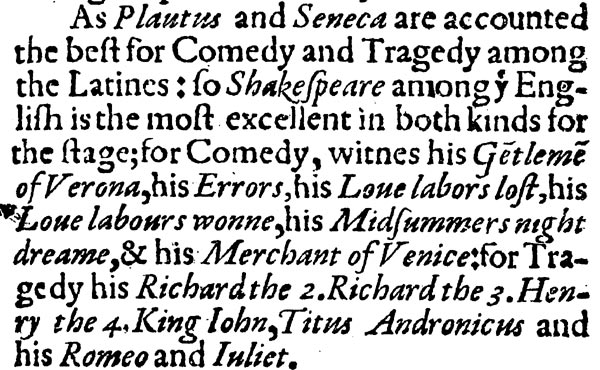
The text of Wit's Treasury that first recorded MND
public domain
Unlike most other Shakespeare plays from before the end of Elizabeth’s reign, MND did not quickly move from the stage to page. It was not until October 8, 1600 the play was even entered on the Stationers’ Register, (the means by which the right to print the play was reserved in this period), by Thomas Fisher, a first-time publisher who would only produce three more titles in an unsuccessful career.
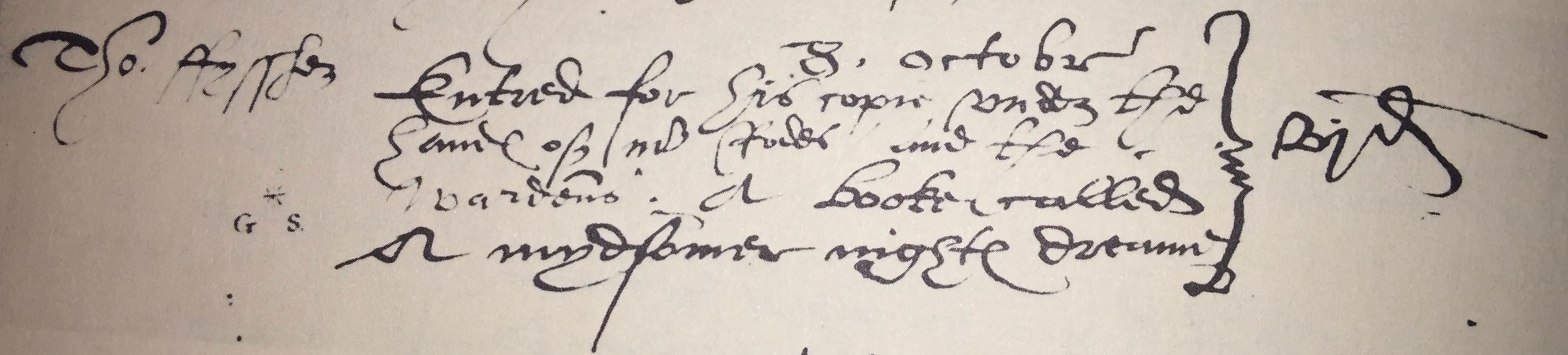
The text of this entry says: 8. octobris
Tho. ffyssher Entred for his copie under the
handes of mr Rodes and the
Wardens. a booke called
A mydsõmer nightes Dreame }vjd
public domain
By the end of 1600 the play had been released in quarto format in an edition printed for Fisher by Richard Bradock, a small-time printer. The title page says that the play had been performed numerous times by the Lord Chamberlain's Men, the theatrical company of which Shakespeare was a member and co-owner. Because no antecedent company is listed it means that the play was probably not performed before the founding of the troupe in 1594, although it could have been initially drafted earlier.
Pre-Printing History
Before turning to the First Quarto, we want to consider the manuscript history of the play before it saw print, which must be speculative because there is no extant evidence. (The term “publication” is being avoided here, and throughout this essay, for the simple reason that theatrical performance was the primary form of publication, in the literal sense of being made public, of the play.) Since Edward Capell first took an interest in such matters in his edition of 1768, it has been generally assumed that the Q1 was set from, and closely mirrors, the playwright’s finished draft manuscript. For reasons extensively outlined in “Editorial Problems and Principles,” this conclusion looks untenable in light of twenty-first century scholarship.
No one seriously contests that Shakespeare created A Midsummer Night’s Dream, but to “wright” a play in the early modern period was to craft, almost literally assemble, a provisional script for performance. It was the starting point for a collaborative process in the playhouse in which the author was, in a famous phrase from Stephen Orgel, “by no means at the center…” He goes on to write, “The text thus produced was a working model, which the company then revised as seemed appropriate.” (p. 2, “What is a Text?”)
What we can say with historic certainty is that, although it is no longer extant, there was once a material form to the “working model.” Contrary to common conception, though, unless it was different from comparable early modern plays, this script was created in pieces and repeatedly revised over a long period of time, in a way socialized by the needs of the playhouse, and later the printhouse. It likely never was polished or finalized in any modern sense.
The Working Model
This “working model” either consisted of, or was turned into, several documents needed to create a performance, at minimum: a “platt,” i.e. a backstage list of scenes for use in what we would now call stage management, the actor’s individual cue scripts from which they learned their parts, and what is now known as a promptbook (although that was not a contemporary term). The company also needed an at least decipherable copy of the play to send to the Master of the Revels for his approval before it could be performed. That approved book may have later been used as the promptbook, but that these two items were the same thing is far from certain.
Lyrics to songs were usually placed in separate documents for use by the composer and musicians. The frequency with which published plays in the period note the location of songs, but without any printed lyrics being included, suggests that these were not copied from a master script into a separate document, but were first set down independently. Only if we are lucky were they later copied back into the “book.” (There is ongoing debate about whether the final lines of MND, in fact, constitute a song or are lines to be spoken after a now-lost song for which we have only a marked location.)
Puck’s final speech is an epilogue that, in the manner of such speeches in the period, would have been created autonomously and treated as a separate item. It may not have been routinely performed. It also may not be the only one ever used with the play. Others, that are no longer extant, might have been written and used for particular occasions as was common practice. MND does not have a prologue, like that of Romeo and Juliet, but that does not mean that it never did—only that it has not survived, for it too would have been a separate document.
Finally, at two points in the play (when a series of titles is proposed to Theseus for his possible entertainment, and later when Quince delivers a prologue to Pyramus and Thisbe) scrolls are introduced onstage, and these might have been read directly by actors who did not have corresponding lines written into their cue scripts. If so, these were yet again separate documents.
Revision
Extant bibliographic evidence in later printed texts suggests that the performance script was revised prior to 1600, and at least once more before 1623, but there is no good reason to assume that these were singular revisions in either case, as opposed to being two discrete moments at which the accumulated revisions (including many which might be invisible to us) were captured in the copy for a particular printing.
This working script, and the associated theatrical materials, would not have made workable copy for a printer. Q1 was set from good copy, however, which (contra the opinion of previous editors) would have had to be assembled and edited from the script into a cleaner, more literary format. Such edited texts, in the shape of scribal copies, are known for many early modern plays among extant theatrical manuscripts. Extensive bibliographic evidence suggests that quite a few Shakespeare plays were copied by scribes whose habits are known, especially Ralph Crane and Edward Knight, that served as the printer’s copy. (Of non-Shakespearean plays several such extant copies were initially made for patrons who wanted personal copies of otherwise unavailable texts, apparently as a literary memento of a performance. The idea that they might be repurposed as printer’s copy may have followed later.)
We do not know where, or by whom, a more literary copy of A Midsummer Night’s Dream was made, but surely one was, judging from the text of Q1, which looks a great deal more like it was set from a scribal copy than a working script. This theory of transmission is far more likely than that the play was originally composed in a conveniently printable form.
The stemmatic diagram below shows the relationships of the inferred documents prior to printing, and the genetic line of the three early witnesses.
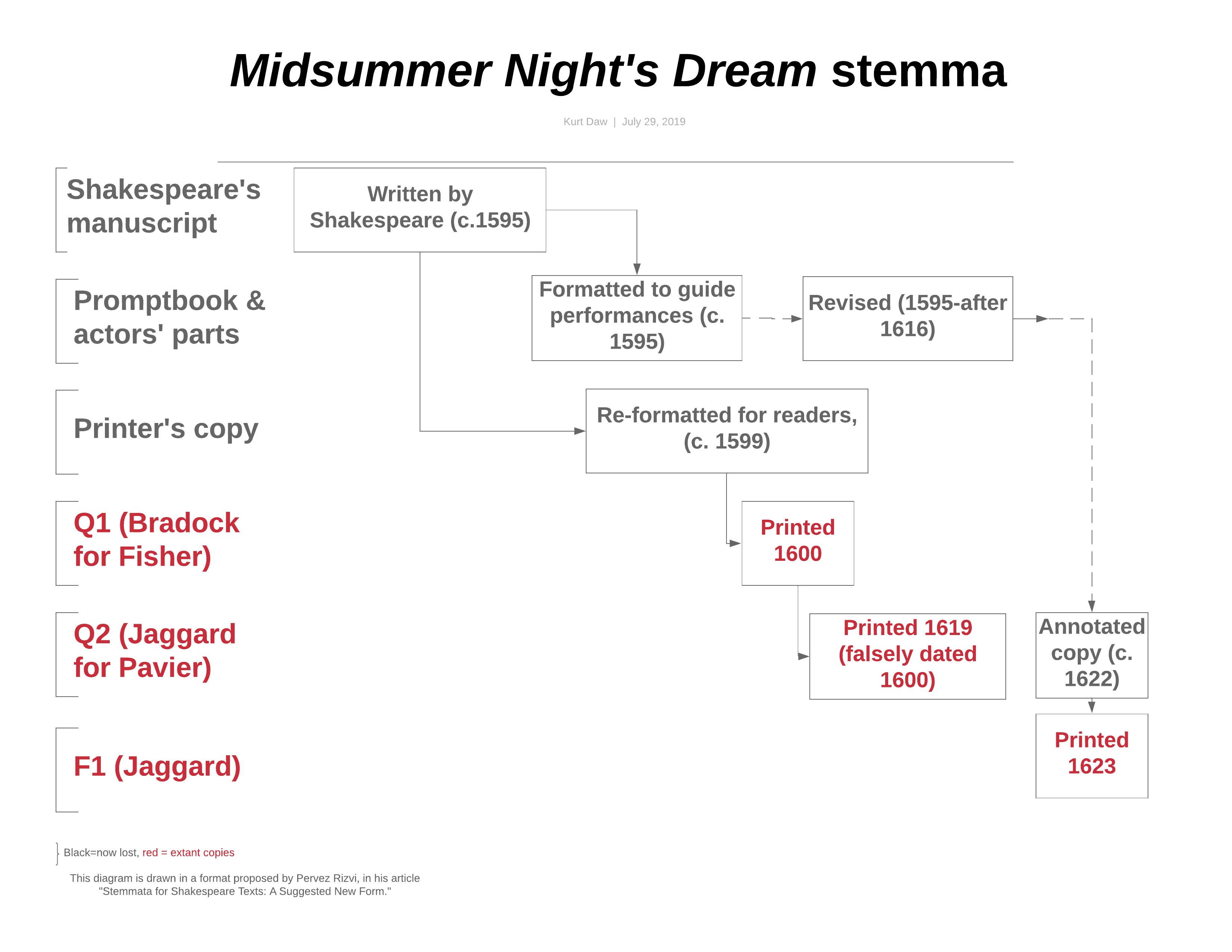
A Textual Stemma for Midsummer
Kurt Daw, owner/creator
First Quarto
This first quarto (Q1) of A Midsommer night’s dreame is quite unusual among early editions of Shakespeare’s plays. It is very difficult to know what to make of the fact that the edition was produced by a first-time publisher and a printer with little prestige. Neither man had any other known connection to Shakespeare, either before or after this edition. (Eight years later Bradock would print one more play, A Yorkshire Tragedy, that was credited to Shakespeare on the title page, but this attribution is false. This should serve, in fact, as counter-evidence of a connection between them.) They were unlikely choices—if, indeed, they were chosen—for any kind of strategy for moving the plays into print, by either the Lord Chamberlain’s Men or Shakespeare himself, as Fisher had no experience of any kind and Bradock’s track record was not promising. Two years earlier he had printed Marlowe’s Edward II in what can only be described, even charitably, as a mess.*
But Fisher may, in fact, have had little trouble reserving the rights to print the play because he may have had no competition. Judging by how long it took MND to make it into print compared to other plays in the repertoire of the Lord Chamberlain’s Men, it is possible established publishers, as well as Shakespeare’s theatre company, no longer thought of it as a valuable asset by the time Fisher took it up. We know so little about the early production record, (See “A Brief Performance History”), we don’t have any idea of the popularity of the play, but it is easily conceivable that in 1600 it was no longer in the active repertoire of the Lord Chamberlain’s Men.
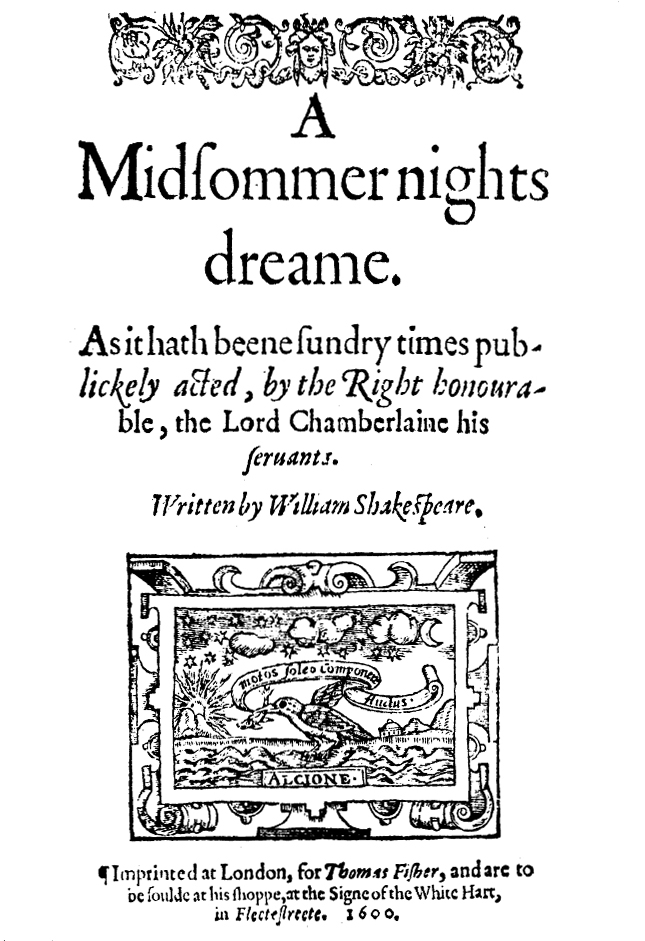
The title page of the first quarto
public domain
Nonetheless, MND is, by the admittedly low standard of plays in quarto in the Elizabethan period, well printed. Q1 is a so-called “good quarto.” It is clean and relatively free from errors such as typos, mislineations, and misreadings of copy. It shows signs of being carefully prepared as a reading text, although perhaps more as a memento of a performance than to ensure “literary” fame, since it has many elements (especially music and magic) that are left undescribed. (See essay, “Four Performance Cruces.”) The aesthetics of the layout and design are plain, but consistent. The evidence suggests it was not, however, commercially successful.
All theories of where and how Fisher obtained his copy are speculative. There is no evidence of either Shakespeare’s coöperation or opposition. (The long-standing belief that the printer’s copy was Shakespeare’s “foul papers” would imply close partnership, but—as outlined elsewhere—this editor doubts this identification of the copy.) Acknowledging that it is also pure speculation, a more plausible theory is that the play was in circulation in a manuscript, likely a scribal edition created for a patron, which Fisher was able to obtain or borrow.
Second Quarto
In 1619, three years after Shakespeare's death, MND was reprinted in another quarto edition that is falsely backdated 1600. (Fisher’s original claim must have lapsed as he had not actively published anything in over fifteen years. The new printer and publisher, William Jaggard for Thomas Pavier, still cautiously issued Q2 with a false date and attributed it to Jaggard’s deceased partner, James Roberts, most likely because they did not clearly hold the rights to print a new edition of the orphan property.) This is one of a group of somewhat mysterious reprints, the so-called “Pavier” Quartos, that were printed at about the same time, of which many are similarly falsely dated.

The title page of the second quarto
public domain
Q2, as the second edition is now usually styled, was completely reliant on Q1 as it repeats quite a number of its mistakes. While it corrected numerous errors, it also introduced new ones. It is of interest as an early example of careful deductive editing, possibly by Pavier himself, but has no substantive corrections that could not have been made conjecturally without consulting separate copy. Its variants, therefore, have no independent authority.
First Folio
In 1623, after many years of compilation, two of Shakespeare's colleagues issued a volume of his collected works. In addition to MND and a number of other plays previously issued in quarto, it included eighteen plays that had never been in print. This very substantial volume was in the much larger, multi-play format known as folio. The Midsummer text in the First Folio (F1) repeats most of Q2's corrections and errors, so it was obviously set from a copy of it, but it also has significant additions that could only have come from consulting an independent source, almost certainly (to use an anachronistic term) the King’s Men’s promptbook. Stage directions are much improved, as are a small number of readings.

The first page of the play from the first folio
public domain
Its most significant departure, however, is hard to evaluate. Philostrate's role as Master of the Revels in Act V is transferred to Egeus. Although reducing the number of speaking roles by one character, it also expands the role of Egeus just enough that, while still small, makes it impossible for the actor to double any other characters in the play. As he easily can do so in the quarto version, there is no net savings of personnel.
It is also a rather aesthetically unsatisfactory combining of two roles that do not seem compatible. It feels like an expedient change, rather than an authorial revision.† Of course, if the alteration was made during his lifetime, Shakespeare would have known about it, but internal evidence from the Folio additions suggests that at least some of the changes date from well after his death, and this one might do so as well.
An equally plausible possibility is that the combination of the roles in the Folio is a result of confusion around what was intended as a doubling of the parts, rather than an amalgamation of them.
Links to facsimiles of Q1, Q2, and F1 are all available in the “Annotated Resources” section of this app, for easy reference.
Endnotes for "Textual History"
*The problems are clearly issues of printing, and not due to bad copy. Running headers, for example, are inconsistent, contain glaring misspellings due to transposition of letters (Traegdie); and twice were incorrectly placed in the form so that facing pages read in one place “The Tragedie The Tragedie,” and in another “of Edward the seconde. ofEdward the second.”
†A few commentators have argued that changing Philostrate to Egeus is a purposeful revision to create a reconciliation between him and Lysander. An obvious objection to this line of reasoning is that it does not actually accomplish this task. At best, it creates an opportunity for implying such a resolution to their conflict sub-textually because there is no onstage moment that does anything more than the part did when it was Philostrate's.